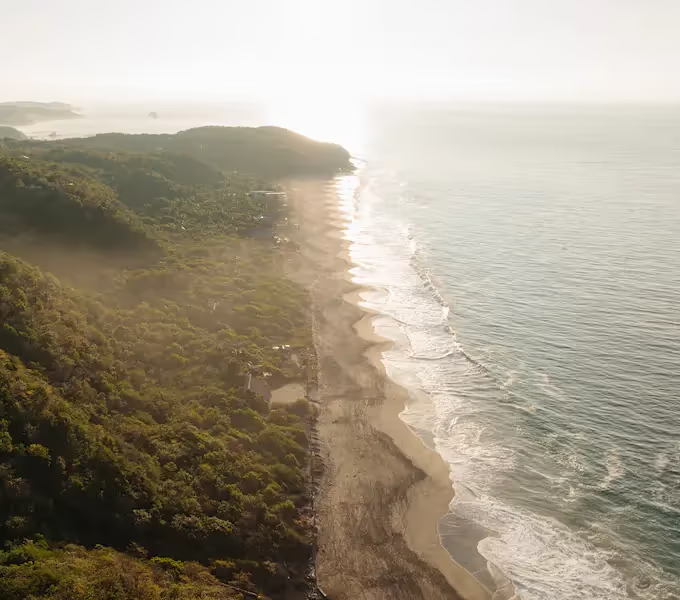
The turtles nest close by. We keep our distance too.
Our private beach sits inside El Torón Reserve, and it's a nesting refuge for sea turtles. That isn't a feature we built. It's the reason the land around us is protected, and it shapes how we run the beach.
Why Mazunte and turtles go together
Mazunte has been tied to sea turtles for as long as anyone has written about it. One reading of the name traces it to the Nahuatl "maxotetia", often translated as "please deposit eggs here". Older residents give a different origin, from "mizontle", a local word for a crab once common here. Both are worth knowing; neither is settled.
The history is less romantic. Through the mid-20th century a market for turtle meat and eggs grew up here, and Mazunte became known for it. That ended on May 28, 1990, when Mexico's president decreed a total and permanent ban on capturing sea turtles and trading in them. The town had to find another way to live with the turtles, and it did.
The Centro Mexicano de la Tortuga
The Centro Mexicano de la Tortuga is the place to understand all of this in an afternoon. It opened in 1991, the year after the ban, as the Museo Vivo de la Tortuga, and it works on the protection of species including the olive ridley. It's in Mazunte itself, close to us, which makes it an easy half-day. Opening days vary through the week, so ask our concierge to confirm before you go rather than turning up on a closed day.
We'd send you there early in a stay. Everything you see on the coast afterwards makes more sense.
The olive ridley and the arribada
The turtle you're most likely to hear about on this coast is the olive ridley, the golfina in Spanish. The IUCN lists it as vulnerable. It's one of the few species that nests in synchronised mass events called arribadas: tens of thousands, sometimes hundreds of thousands, of females coming ashore over a few nights.
Oaxaca's best-documented arribada beach is La Escobilla. Researchers studying it in 2005 ran night patrols from May to November and recorded five arribadas in that stretch. That gives you a fair sense of when this coast is busiest with turtles: the rainy months into autumn, when El Torón is at its greenest. El Torón changes with the season, green to gold, and the turtles follow the green half.
We can't promise you'll see a turtle on any given night. Nobody honest can.
How we look after our beach
We treat the beach as a refuge first and a place to swim second. In practice:
- Reef-safe only: we stock reef-safe sunscreen and after-sun lotion, and we'd ask you to use those rather than what you packed.
- No single-use plastic: it's banned across the hotel, beach included.
- Walk or cycle: we encourage walking over cars, and bicycles are free for guests.
- Wildlife first: El Torón is a protected natural area. If you meet an animal on the paths or the sand, give it room and let our team know.
If a nest is marked or a turtle is on the beach, the same rule applies. Watch from a distance and leave it be.
Making turtles part of a stay
Our experiences program, The Voyage Within, has an Explore stream for nature and the outdoors, and your concierge is the person to ask about what's running on the coast while you're here. Pair it with a visit to the Centro Mexicano de la Tortuga and a few slow mornings on our own beach.
Practical notes: this is adults-only, from eighteen up. Breakfast is included. We're about 50 minutes from Huatulco airport and an hour from Puerto Escondido, and we arrange private transfers from both.